Ingrid Lekk's new paper on Sox1a and the parapineal published in eLife

Ingrid Lekk's new paper on Sox1a and the parapineal published in eLife

The Wilson labs latest paper on one of our favourite structures the parapineal has just been published in eLife. In this work , Ingrid shows that normal function of Sox1a is required for the parapineal to impart left-sided molecular character and efferent connectivity to habenula neurons, despite not being required for the specification and migration of the parapineal itself.

Read this open access paper in eLife:

Sox1a mediates the ability of the parapineal to impart habenular left-right asymmetry. eLife 2019;8:e47376 DOI: 10.7554/eLife.47376

or check out the publication summary.

Authors :Ingrid Lekk, Véronique Duboc, Ana Faro, Stephanos Nicolaou, Patrick Blader, Stephen W Wilson

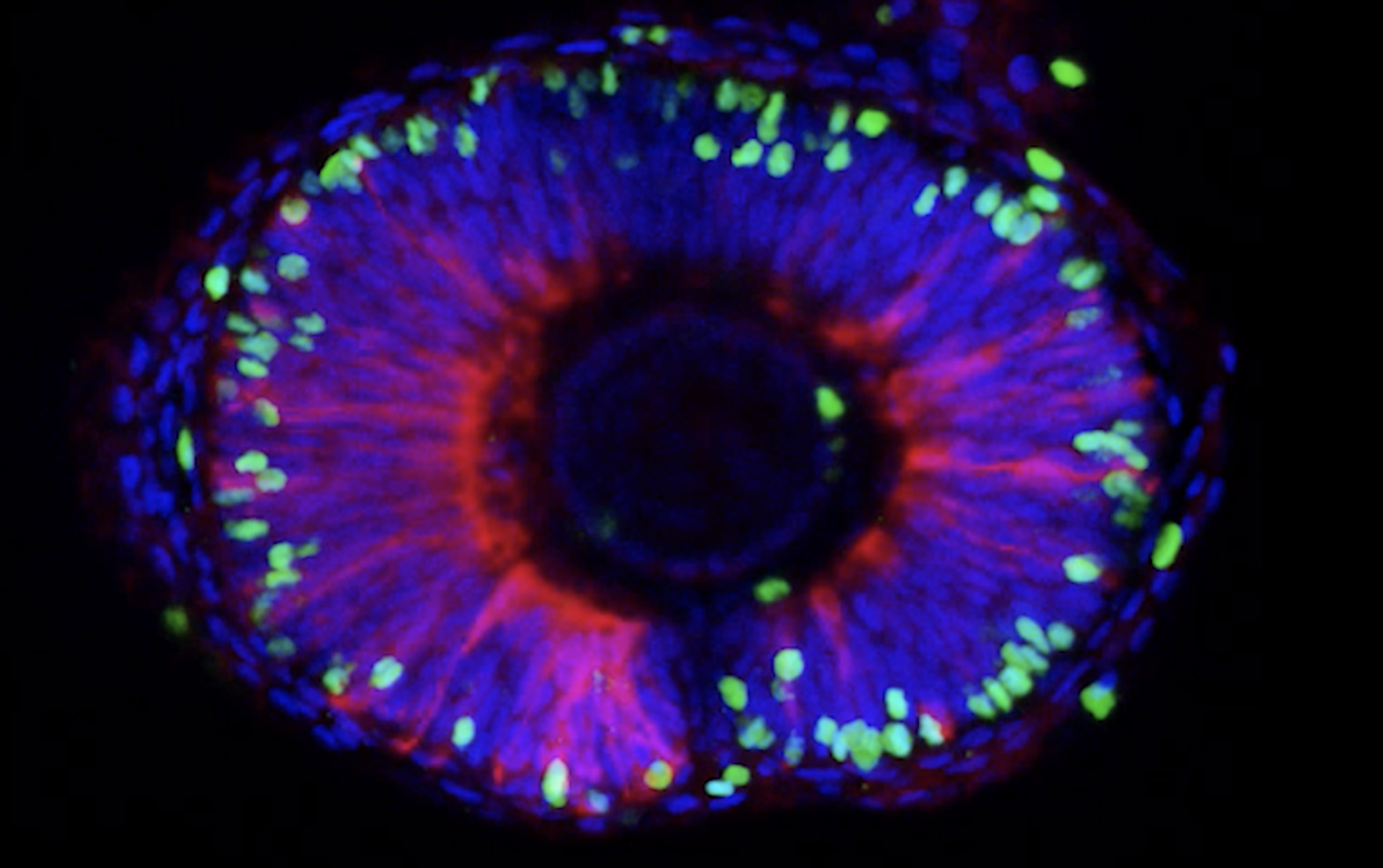
The parapineal emerges from the pineal during zebrafish embryogenesis, as shown by confocal images of a transgenic line with GFP in the pineal complex (top pictures). The pineal complex lies at the midline of the epithalamus, flanked by left (green …

The parapineal emerges from the pineal during zebrafish embryogenesis, as shown by confocal images of a transgenic line with GFP in the pineal complex (top pictures). The pineal complex lies at the midline of the epithalamus, flanked by left (green on the scheme) and right (magenta on the scheme) habenulae. The habenulae are innervated by the parapineal and themselves send neuronal projections to the midbrain interpeduncular nucleus (IPN). The side of the parapineal, on the left in wild-type (wt), determines which habenula acquires a left-type identity projecting to the dorsal part of the IPN (dIPN).

Congratulations to Ingrid!

Ryan MacDonald to join UCL Institute of Ophthalmology.

Ryan MacDonald to join UCL Institute of Ophthalmology.

Dr Ryan McDonald, a BBSRC David Phillips Fellow is joining the Institute of Ophthalmology, UCL from the University of Sheffield where he is JG Graves Medical Research Fellow in department of Infection, Immunity and Cardiovascular Disease.

Ryan’s lab will study the role of cell adhesion molecules in glial morphogenesis using the zebrafish retina as a model system. Click here to see the UCL press release and read more about the MacDonald Lab research.

Ryan.jpg

Dr Renato!

Dr Renato!

Congratulations to Renato on getting his doctorate.

Fellowship Award to Asaph!

Fellowship Award to Asaph!

Congratulations to Asaph who was recently awarded a prestigious BBSRC Discovery Fellowship. It is all the more impressive because this is the first Discovery Fellowship ever awarded to any UCL researcher!

The award will allow Asaph to combine cellular resolution whole-brain functional imaging in larval zebrafish and modern machine learning techniques, to study how the brain transforms visual input to behaviour.

https://www.ucl.ac.uk/biosciences/biosciences-news-publication/2018-2019/discovery-fellowship-asaph-zylbertal

IMG_20181218_183414-01.jpeg

Pedro's viva!

1fa3b540-3a9f-4215-9aeb-44eda83c78e3.png

We’re all extremely proud of Pedro who by all accounts nailed his viva today [err, actually yesterday - ed]! First Bianco lab PhD… Celebrations much deserved!

2d4489ac-1b1d-400a-af6e-acfe75e476ab.jpeg
cfe68897-5f86-4f64-b555-231a67bcc507.jpeg
d7c03e16-0769-4fbf-a95a-4f96a9cde317.jpeg

2018 Project Students

IMG_20181112_173756-1.png

The Bianco lab are pleased to welcome Kristie, Nicole and Adam (from left to right), who will be doing their research projects with us this year.

ZENITH training programme is funded!

Zenith Final Logo.png

The Bianco lab are really excited to be part of a consortium that has been awarded funding from the EC Horizon 2020 ITN scheme. Our ZENITH (ZEbrafish Neuroscience Interdisciplinary Training Hub) programme will be training 15 graduate students in interdisciplinary systems neuroscience projects investigating sensorimotor processing using larval zebrafish.

Congratulations to everyone in the consortium and especially Claire Wyart and Alexandra Chukas for coordinating it all.

Thesis hand-in!

IMG_9231.png

Congratulations to Pedro, who handed in his PhD thesis today!

FENS 2018

Joanna attends FENS 2018

Anna Krasnow's paper shortlisted for the MS Society Awards 2018

Anna Krasnow's paper shortlisted for the MS Society Awards 2018

The paper entitled: "Regulation of developing myelin sheath elongation by oligodendrocyte calcium transients in vivo"  and published in Nature Neuroscience in 2018 by Anna Krasnow, David Attwell and colleagues, has been shortlisted as a finalist for the MS Society Awards 2018

'In Multiple Sclerosis(MS), the myelin coating that protects our nerves is attacked by the immune system. To stop MS, we need to understand more about how myelin is made and repaired.

The researchers showed that calcium controls the development of myelin in zebrafish. High levels of calcium promoted myelin development whilst low levels prevented myelin development.
These results support further research into myelin development and repair in MS.’

Welcome Charlie!

Welcome to Charlie, a Wellcome Trust 4 Yr PhD student who is rotating in the lab. And also Happy Birthday to Megan!

IMG_7539_edit.jpg
IMG_7528_edit.jpg

Packed Lunch: Zebrafish and Human Behaviour

Packed Lunch: Zebrafish and Human Behaviour

Join Elena Dreosti at the Welcome Trust to discuss: "What makes us social?" and explore how zebrafish help her to answer this question. 

Click this link to go to the Wellcome Trust website and see the details for this workshop. 
 

Wednesday 24 January 2018
13:00-14:00

Anna Krasnow's work on myelination is published in Nature Neuroscience

Anna Krasnow's work on myelination is published in Nature Neuroscience

Anna Krasnow, a PhD student on the Wellcome Trust Neuroscience program, has just published her study on myelination in Nature Neuroscience. Anna, who is predominently based in David Attwell's lab at UCL, collaborated with Leo Valdivia in Steve Wilson's group on this work. The resulting paper looks at the role that calcium transients in oligodendrocytes have on the developing myelin sheath. Anna found that neuronal activity raises calcium levels in developing oligodendrocytes and that myelin sheath elongation is promoted by high frequency calcium transients. 

Congratulations Anna et al on a beautiful study!

Click this link to read the accompanying News and Views piece on this study in Nature Neuroscience. 


Screenshot 2017-12-13 10.48.22.png

Welcome Holly and Dammy

IMG_6988_ed.png

The Bianco lab are pleased to welcome two new project students for 2017-18: Holly (MSc) and Dammy (MSci).